
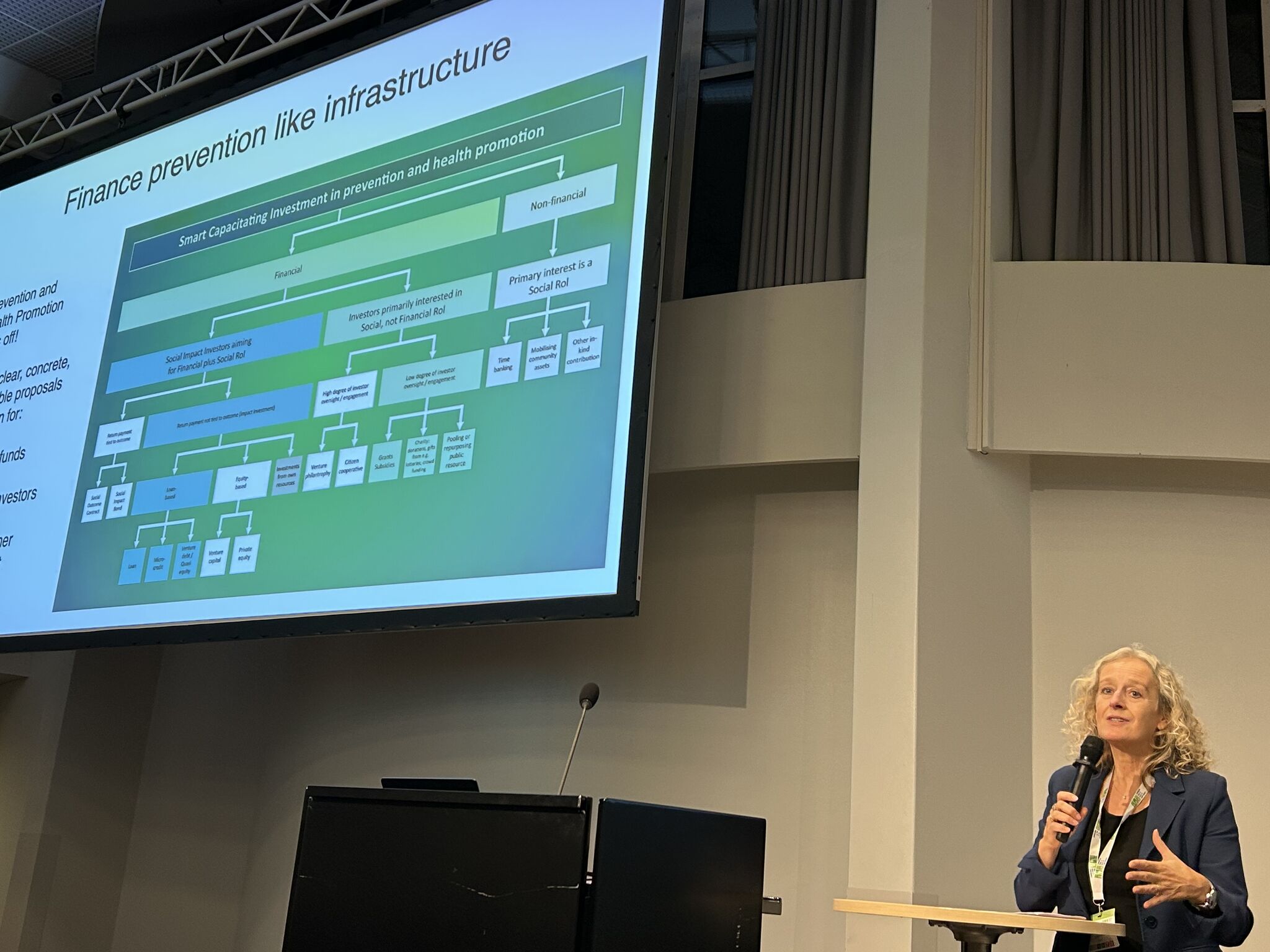
At a recent Invest4Health workshop in Helsinki at the 18th European Public Health Conference, participants from policy, public health, research, and financing communities came together to explore how prevention can be designed and financed as a long-term investment. The workshop focused on translating the concept of Smart Capacitating Investment (SCI) into practical thinking and concrete action at the regional and local levels.
The session was designed as an interactive working space rather than a traditional conference panel. After introductory inputs and short “spark” interventions, participants moved into table-based group dialogues to reflect on their own experiences and systems.
Creating space for dialogue
Each group was invited to discuss three guiding questions:
- What do you associate with the word “investment”?
- Where could Smart Capacitating Investment make the biggest difference in your system or community?
- What would make this possible, and what could block it?
Groups were asked to summarise their discussions in one key sentence and to appoint a “table voice” to share insights with the wider group. Participants used post-it notes to capture ideas, challenges, and opportunities, which were then clustered into common themes.
This format encouraged open exchange and helped bring together perspectives from different sectors and professional backgrounds.
Shifts that can be made now
One of the main outputs of the group discussions focused on practical changes that could be implemented in the short term. Participants highlighted several concrete priorities:
- Strengthening public health capacity by including skills such as fundraising and investment management within public institutions
- Translating existing experience with Social Impact Bonds into broader public health practice
- Improving literacy around business models and investment mechanisms
- Learning more about the priorities and expectations of potential investors
- Moving from process-focused evaluation towards outcome-oriented approaches
- Breaking down sectoral silos and applying integrated perspectives such as One Health
- Embedding prevention more clearly within wider system strategies, such as reducing emergency care demand
These reflections showed strong interest in professionalising prevention financing and strengthening institutional readiness for innovative investment.
Ideas to take forward
Participants also identified several medium- and long-term ideas that could support the development of sustainable prevention investment ecosystems:
- Strengthening collaboration between public health and other regional government departments
- Developing new types of public health investment tailored to specific challenges such as non-communicable diseases and environmental health
- Aligning prevention investment more closely with wellbeing economy principles rather than GDP-focused metrics
- Using population health data more strategically to understand and engage potential investors
- Creating favourable investment environments before seeking external funding
- Encouraging public health professionals to reflect more actively on where resources are invested and what risks are involved
- Expanding the use of social return on investment approaches
These ideas reflect a growing recognition that successful prevention financing depends on system-level alignment, not only on individual projects.
Open questions for future work
Alongside concrete proposals, participants identified important questions that require further discussion and research:
- What role should private funding play in health promotion?
- Could institutions such as churches or political organisations become responsible social investors?
- How can public health teams access expertise in business modelling and investment design?
- Should European-level platforms be created to share public health business cases?
- At which level should investment be targeted: pilots, population groups, thematic programmes, regional systems, or national strategies?
These questions underline the need for continued dialogue and evidence-building in this emerging field.
Key takeaway messages
The workshop concluded with a set of shared reflections that summarised the collective learning:
- Smart Capacitating Investment reframes prevention as something that can be financed differently
- SCI is built on four operational principles: shared value and shared risk, innovative financing, focus on results, and investment at scale
- SCI changes how resources flow, how equity is built, and how public value is created
- SCI is grounded in real cases and should be shaped collaboratively rather than imposed
- SCI is supported by validated tools and practical resources
- Social Outcome Frameworks can serve as important vehicles for making SCI operational
These messages reinforce the idea that prevention financing is not an abstract policy ambition, but a practical field that can be developed through shared learning and experimentation.
Strengthening capacity for prevention investment
The Helsinki workshop demonstrated the value of creating structured spaces for dialogue between public health professionals, policymakers, and financing actors. By combining conceptual discussion with practical reflection, the session helped participants connect investment thinking with everyday prevention practice.
The insights generated during the workshop now feed into Invest4Health’s wider work on capacity building, tool development, and policy engagement. They also contribute to the joint work with partner initiatives on developing guidance and White Papers for future prevention investment.
Through activities like this workshop, Invest4Health continues to support regions and organisations in building the knowledge, confidence, and partnerships needed to treat prevention as a strategic, long-term investment in health, equity, and social resilience.
Feeding into policy and joint work with THCS
The insights and experiences gathered during the Helsinki workshop are directly informing Invest4Health’s joint work with the Transforming Health and Care Systems (THCS) Partnership WP9. The practical reflections on financing models, governance arrangements, and stakeholder collaboration provide valuable input for ongoing policy-oriented activities.
These lessons are being integrated into the development of a joint White Paper, which aims to translate project results and field-based experience into concrete policy considerations and recommendations. By linking regional practice with European-level policy dialogue, this work supports the creation of more coherent frameworks for financing health promotion and disease prevention.
In this way, the workshop contributes not only to mutual learning among participants but also to shaping future strategies for prevention investment and health system transformation across Europe.